Friday morning began with a pre-dawn wake-up call from the corniche: it was election season, and one candidate’s supporters blared messages from amplified bullhorns as they cruised the street. Voting is compulsory (people are fined for not voting), and vote buying is common – a bottle of cooking oil in exchange for a vote is a good deal in today’s economy. Egypt also has a 40% illiteracy rate and a history of voter suppression, so people here don’t put a lot of faith in elections.

Once the sun rose, I found myself facing a navigational challenge: how to persuade the Sohag Azure Hotel’s elevator to release passengers on the floor they wanted, rather than on whatever floor the elevator chose. After the up-and-down trips for breakfast revealed the elevator’s intransigence, I opted for the stairs to return for Wolfram’s lecture on the cemetery of Meir, the objective of today’s visit.
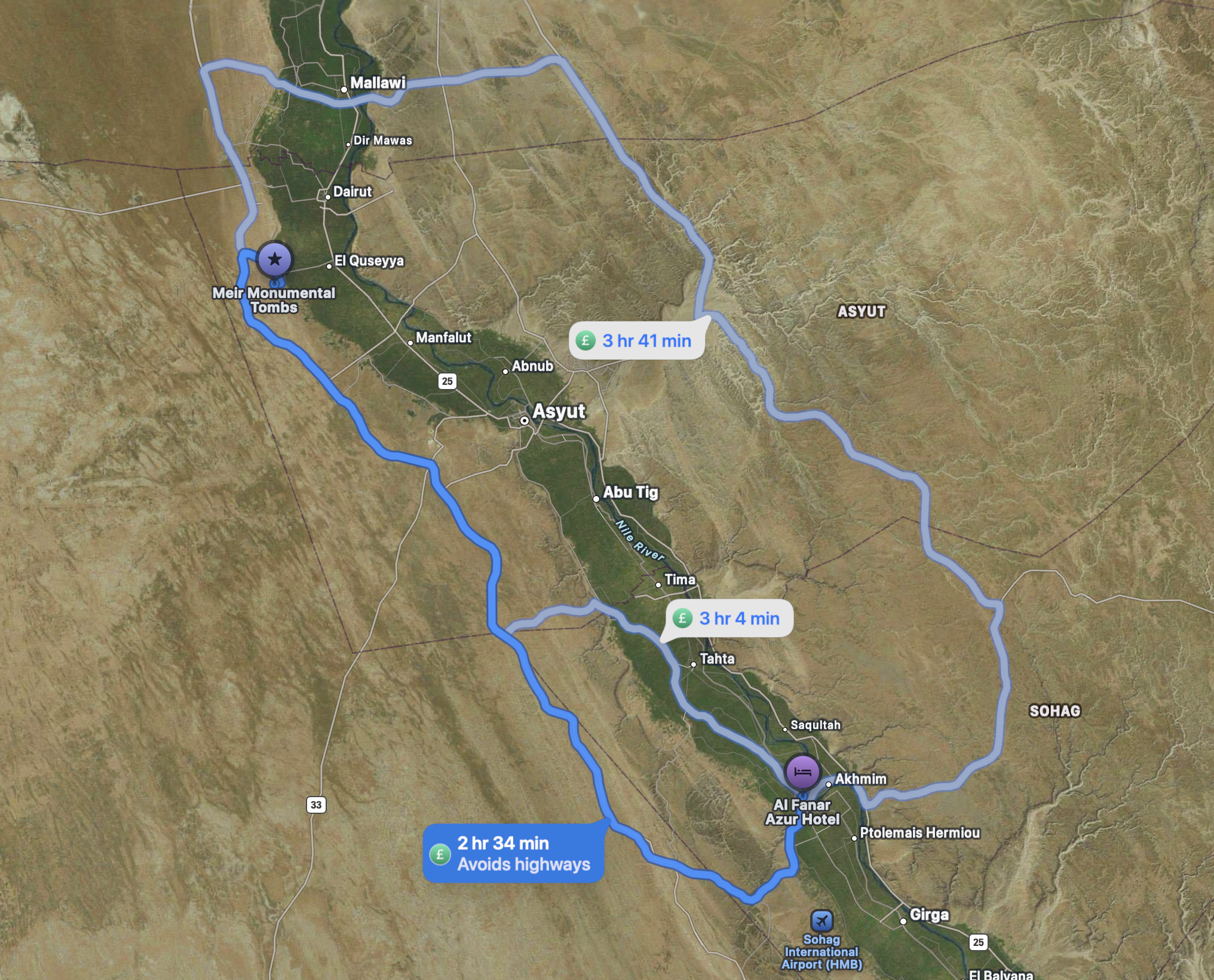
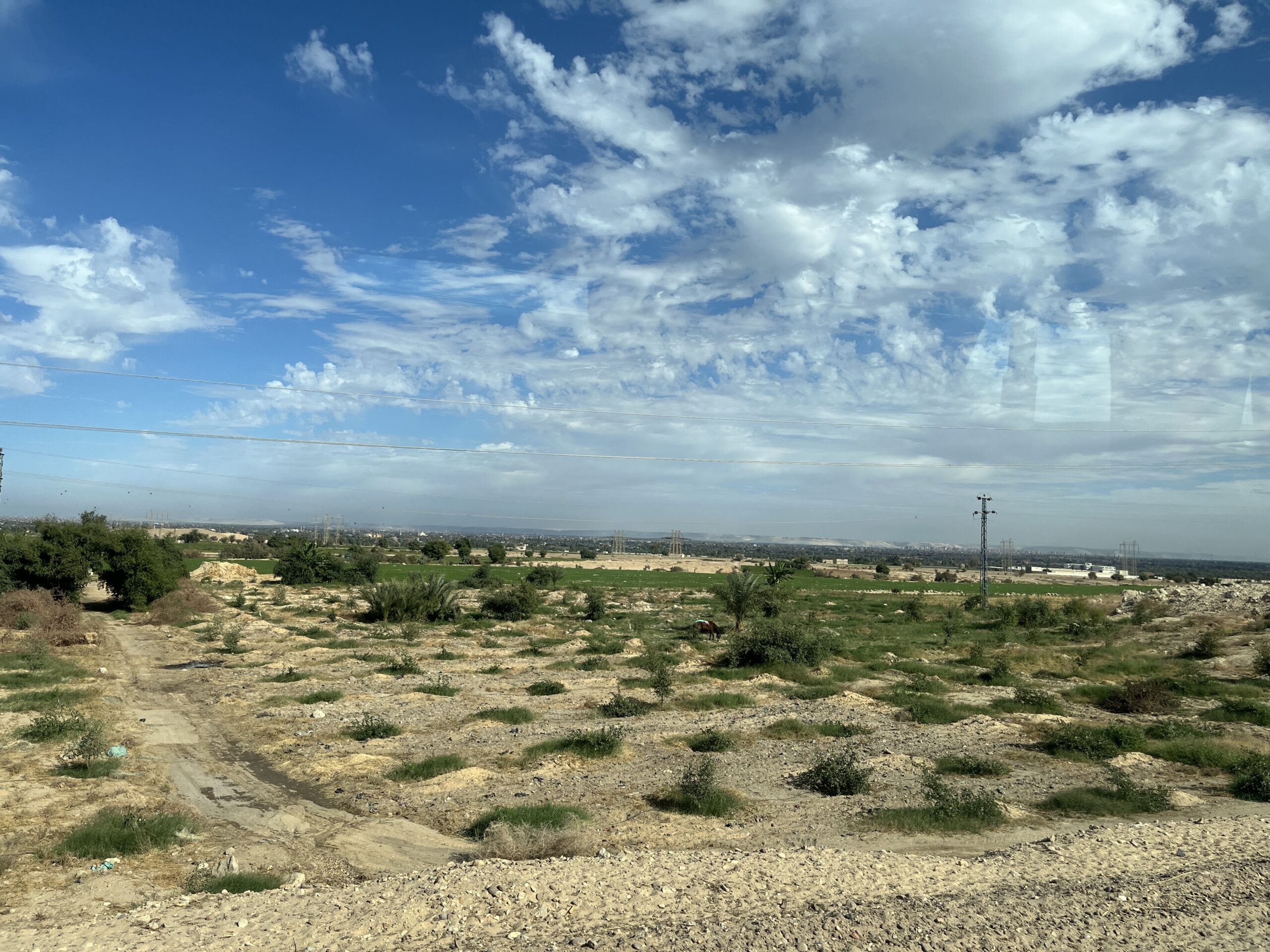
We departed under cloudy skies accompanied by a full contingent of police escorts. (Our return from Hammamiya the night before warranted the full lights-and-sirens treatment. I felt very inconspicuous.) We traveled down the corniche and onto the western desert road.


There was the usual confab among security folks at the provincial border, then we continued north past Asyut.
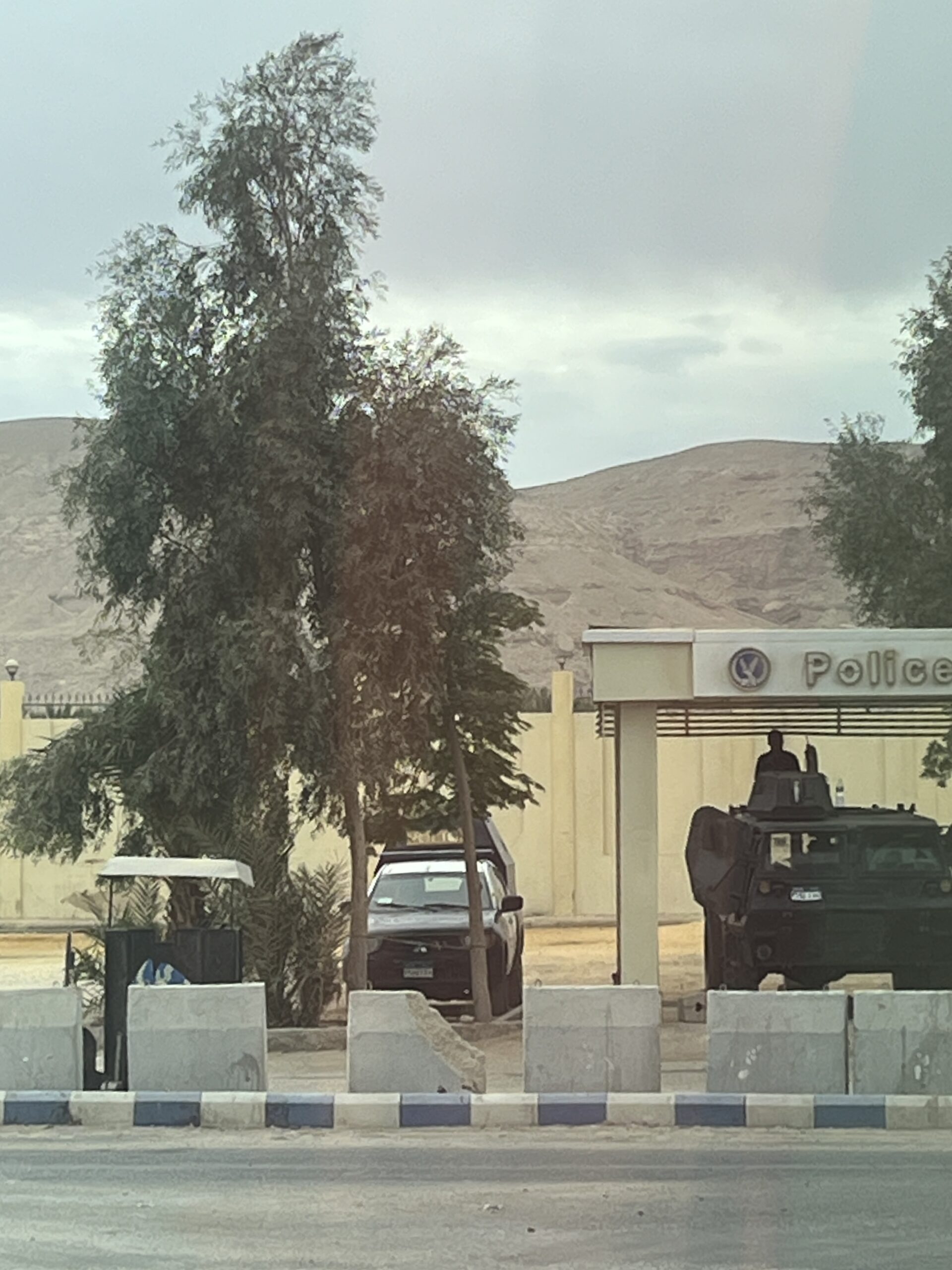




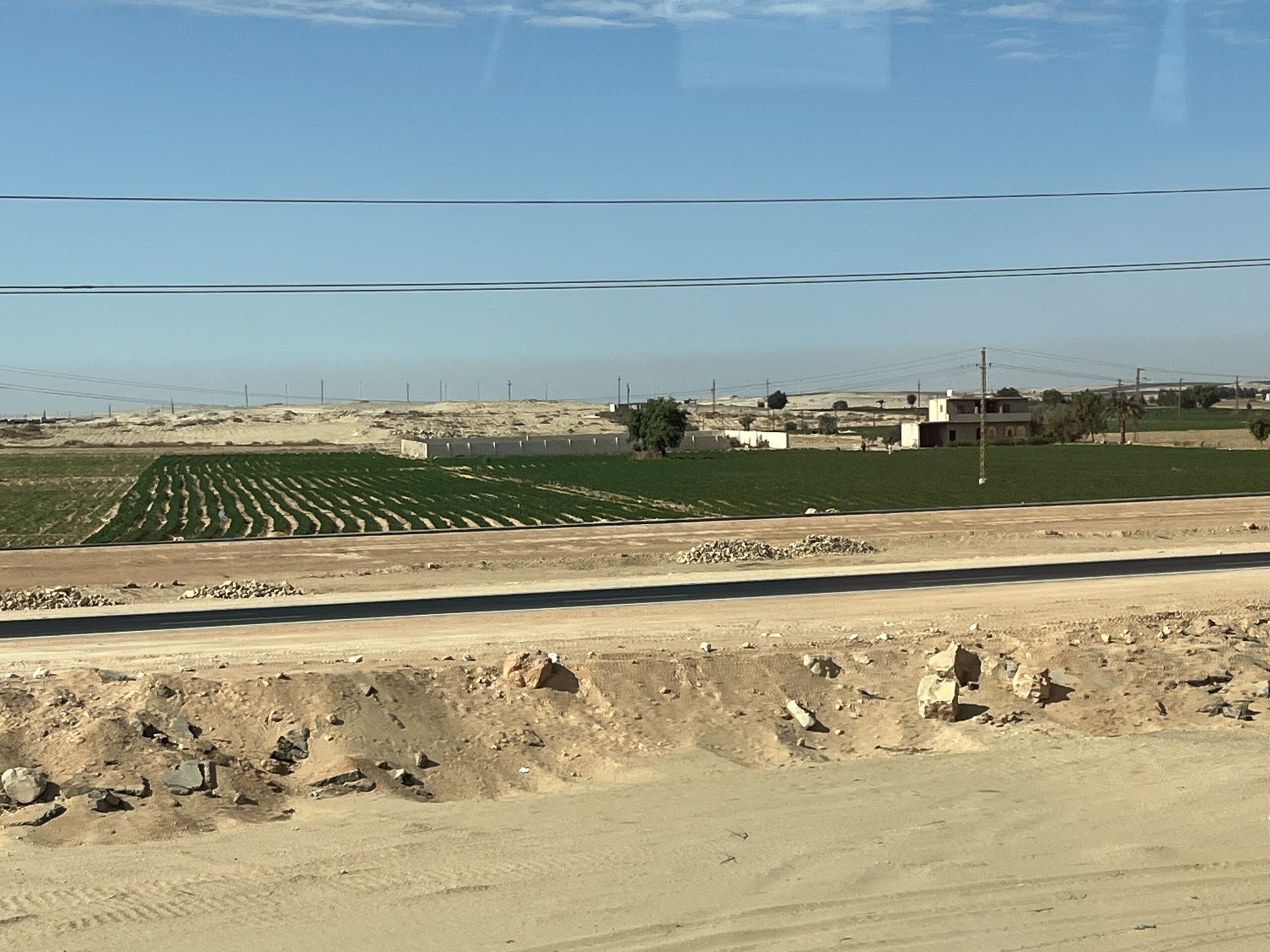
Today’s bathroom break came at a gas station on the Sohag-Cairo-Asyut highway intersection. The station wasn’t the cleanest, but it served the purpose.




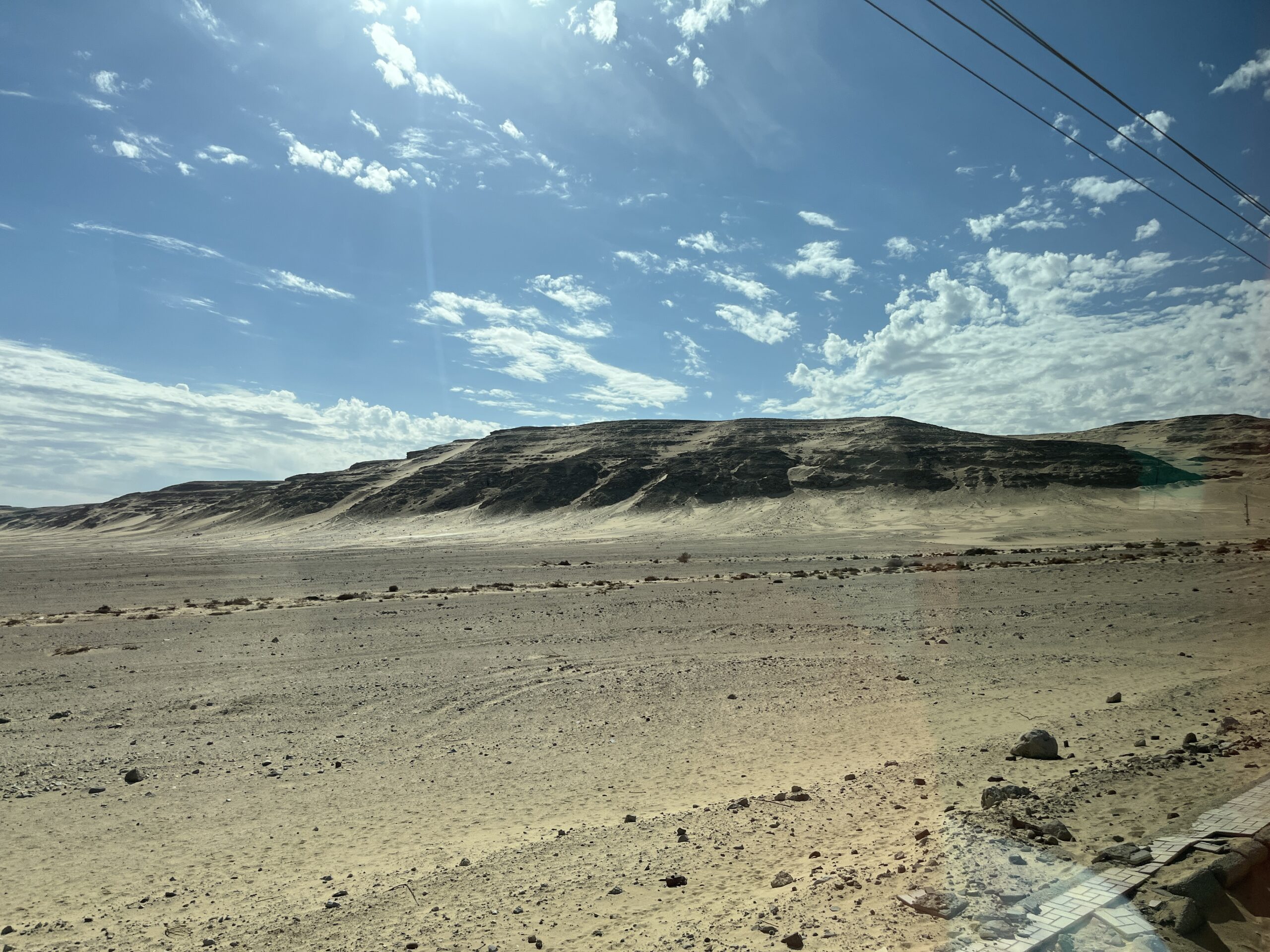
The Cemetery at Meir
Qis/Qusae (modern al-Qusiya) was the capital of the14th ancient Egyptian nome. It was a major center for the Hathor cult, with a temple comparable in size to the lovely temple of Hathor at Dendereh. From the 6th dynasty on, nearly every governor held the title “Overseer of Prophets of Hathor, Mistress of Qis,” and the women of the governing family were routinely recorded as “Priestesses of Hathor.” There have been no systematic excavations around the city, so the location of the temple is unknown.
Two cemeteries were used by the nobility of Qis during the 6th Dynasty: Quseir al Amarna, located on the Nile’s east bank, about 5 kilometers (~ 3 miles) northeast of the ancient capital, and Meir, located on the Nile’s west bank about 8 kilometers (~ 5 miles) southwest of Qis.
In the late 6th dynasty (reign of Pepi II), elite burials were moved to Meir, located on the Nile’s west bank, about 7 kilometers (~ 5 miles) southwest of Qis and ~11 kilometers (~ 7.5 miles) from the older cemetery. Elites were buried in rock-cut tombs, while lesser officials were buried on the plains, in largely unexcavated cemeteries. The 18 decorated tombs at Meir are from the 6th dynasty (Old Kingdom, reigns of Pepi I – Pepi II, c. 2276 – 2153), and the first half of the 12th dynasty (Middle Kingdom, reigns of Amenemhat I, Senusret 1, Amenemhat II and Senusret II of the 12th Dynasty c. 1991 – 1878 BCE).
Why did the location of elite burials change from Quseir to Meir? The 6th Dynasty seems to have been a tumultuous time in Egyptian history. Egyptologist Naguib Kanawati wrote a fascinating book, Conspiracies in the Egyptian Palace, Unis to Pepi I, using archeological evidence to argue that three conspiracies affecting the royal house occurred in the early 6th dynasty: the assassination of Teti (first 6th Dynasty ruler); an attempt to replace Teti’s son Pepi I, led by a royal wife; and a later revolt against Pepi 1 by elder sons who had been disinherited through Teti’s maneuverings when he took the throne. It’s a great read, bringing dry Egyptology to life a là House of Cards.
Pepi I (c. 2332–2283 BCE) responded to these conspiratorial shenanigans by overhauling administration of the country and appointing his own loyalists to positions of power in the provinces. The first two men he appointed to govern Qis/14th nome are buried, with their families, at Quseir. This marked the beginning of the powerful “Pepy-ankh” family, who ruled over the nome in various capacities for six generations.
Some 70+ years later, Pepi II (c. 2284 – 2214 BCE) reformed the administration again, dividing the country into three units with a “vizier” managing each one. (These were the most powerful positions in the country, after the ruler.) Midway through Pepi II’s very long reign, the seat of the southern “vizier” was moved from Abydos to Qis with the Pepyankh family continuing in power.
There do not appear to have been any burials at Meir during the First Intermediate Period. When powerful nomarchs re-emerged in the 11th Dynasty, they continued to use the cemetery at Meir for their burials.

As an aside, Akhetaten, the city of the sun god Aten (known today as Tell el-Amarna) was established by the heretic pharaoh Akhenaton about 15 miles northeast of Qis. When founding the city, Akhenaten proclaimed that he had selected a virgin, uninhabited site, far from the established temples of traditional Egyptian gods. I’ve always pictured Akhenaten as being in the middle of nowhere, but, In fact, it was located in one of the richest provinces in Egypt and practically next door to a major Hathor temple. Go figger…

The tombs at Meir extend ~ 1.5 km north to south along the cliffs, on both sides of a shallow wadi. Aylward Blackmun was the original excavator/recorder (1912-1953), and he established the numbering system still used today. He divided the Meir cemetery into five groups, based roughly on their location, date and familial connections.
- A (tombs of the Sixth to Eleventh dynasties)
- B (tombs of the Twelfth dynasty)
- C (tombs of the late Twelfth dynasty)
- D (tombs of the Sixth dynasty, including the first tombs constructed at Meir)
- E (tombs primarily of the Sixth dynasty)
Naguib Kanawati published a follow-up series, The Cemetery of Meir, from 2012 onwards (Australian Centre for Egyptology). Restoration work began in 1997 and tombs were opened to the public relatively recently.
All of the tombs are similar in construction: chapels of varying size carved into the rocky cliff, with statue niches and underground burial shafts. Some chapels include more than one room (within or extending from the main chapel) with multiple family members commemorated and buried in the same complex. Chapel walls were decorated with carved and painted reliefs or painted frescoes.


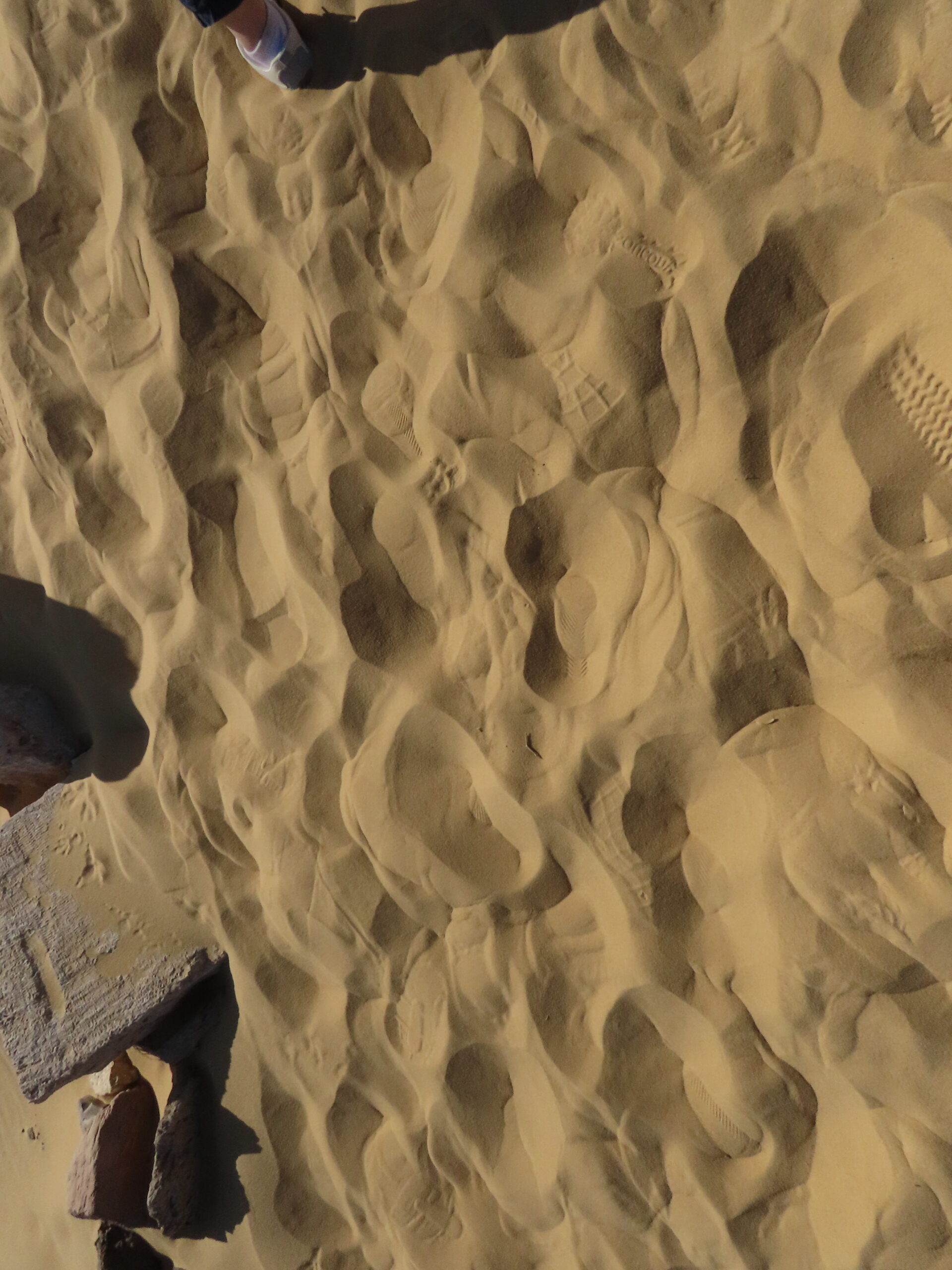




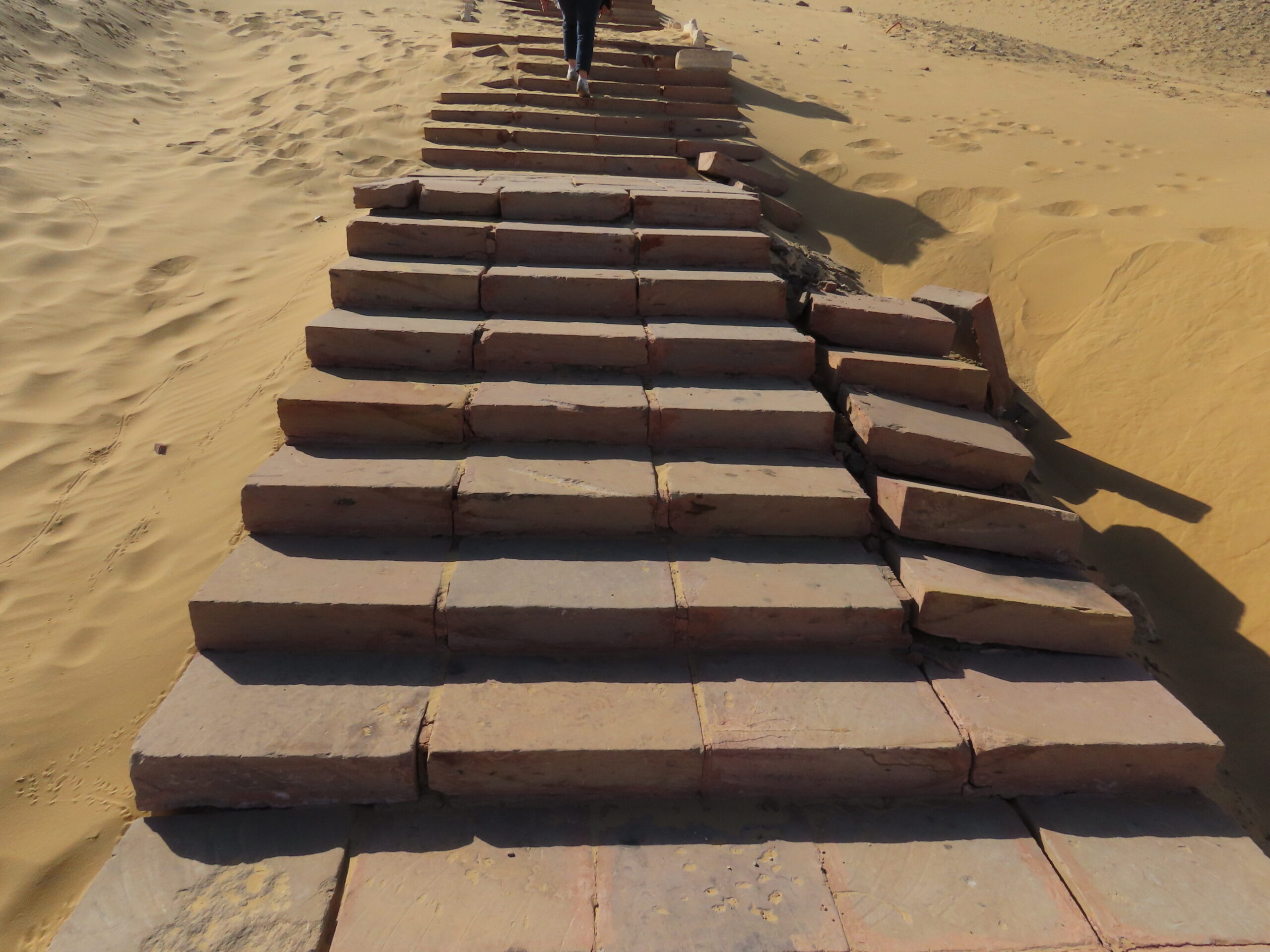
It was another long, uphill slog across stone and sand.


Middle Kingdom Tombs
By the time Mentuhotep 2 reunited the country (mid-11th dynasty, c.2040 BCE), the core Middle Egyptian nomes were controlled by a network of powerful families who intermarried, and passed their titles and authority to sons, independent of the ruler. The first four rulers of the 12th dynasty tolerated this situation, confirming many governors/nomarchs in their titles and thus ensuring their continued wealth. Titles came with lands and agricultural resources, which were lost when titles were passed on to someone else.
But Senusret III (the 12th dynasty’s fifth ruler, c. 1878-1839 BCE) stopped the governors’ ability to appoint their own successors. Like Pepi II, he divided Egypt into three districts and appointed “viziers” to assume the authorities that nomarchs had held. This administrative change appears to have reduced the wealth of these powerful families, and ended the era of enormous decorated, rock-cut tombs for governors.
Similarly to the Old Kingdom, six generations of the same powerful family served as nomarchs at Qis during dynasties 11-12. Unlike the better known tombs at Beni Hasan (tomorrow’s visit) these governors did not leave long biographies in their tombs so little is known about them beyond their primary titles and family connections.
We visited three 12th dynasty Middle Kingdom tombs:
- Senebi I (Tomb B1) reign of Amenemhat I
- Ukhhotep II (Tomb B2) reign of Senusret I
- Ukhhotep III (Tomb B4) reign of Amenemhat II
(Note: Although all of these nomarhs lived during the 12th dynasty, only Ukhhotep III is securely dated to the reign of Amenemhat II. The others are assigned to reigns based on stylistic grounds and notes from other monuments.)

Senebi I
Senebi 1’s primary titles were Hereditary Nomarch, Overseer of Prophets, and Chancellor of the King of Lower Egypt. Senebi’s chapel is typical of the tomb architecture here: a large hall with a statue niche at the end, and burial shafts below. The pillars you see in photos were added for support during reconstruction.


The reliefs lack detail (and were hard to photograph in dim light) but a lot of color remains. Scenes depicted are typical of the period: the tomb owner overseeing a parade of shepherds, butchers, sacrifice bearers, priests, fighting bulls, men leaping over bulls, and a cow giving birth; the tomb owner at a feast with dancers and musicians, offering bearers and wrestlers; people engaged agriculture and craft activities; fishing in the marshes; and a unique hunting scene: Senebi leaning forward as he aims his bow at desert prey (depicted in the sketch below). The high quality of these reliefs suggests that the artists were borrowed from the royal workshops.


Senebi’s wooden coffin is displayed in the Grand Egyptian Museum and it is a gorgeous creation. Note those penetrating eyes above the false door, providing Senebi with a view into the living world, and the means to travel back and forth.


Ukhotep II
Our second visit was the tomb of Ukhhotep II, Senebi’s son. Based on his titles, he seems to have climbed higher up the career ladder than his father: Hereditary Prince and Count; Chancellor of the King of Lower Egypt; Overseer of Prophets of Hathor, Mistress of Cusae; Overseer of Priests of the Lady of All; Royal Sealer; Chief Lector Priest; and Sem-Priest. He also held the title “Great Overlord of the The Atfet Nome,: suggesting that he may have had authority over the 12th and 13th nomes as well as the 14th. (Then”Ukh” in his name references the traditional god and emblem of the 12th nome.)


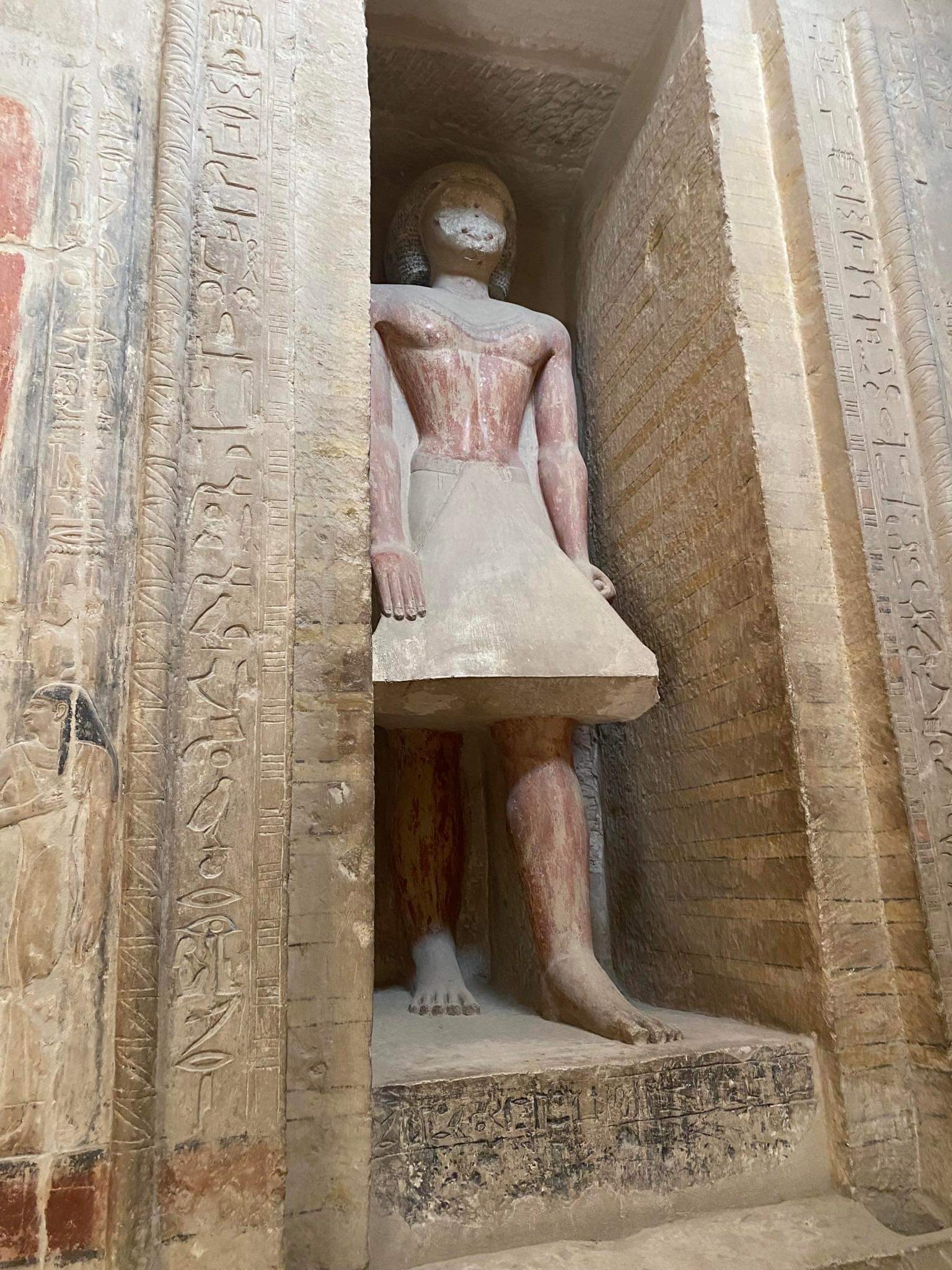
Below is the richly decorated niche where a statue of the owner would have stood, ready to receive offerings and prayers from family members and retainers.


The reliefs in this tomb are noted for their realism, although they are in various stages of completion. Many were never painted. Below are images from the chapel’s north wall, including cattle, bulls fighting, a man carrying papyrus reeds on his back and musicians entertaining Uhkhotep (including the orchestra leader at the back). Note the rectangular grids above the musicians, which were created by artists from Dynasty 26 (c. 664 BC–525 BCE) who were copying these reliefs to re-learn the art, more than 1300 years later.


Images from the west wall depict Ukhhotep and his wife Djehutyhotep sitting before an offering table while goodies are carried forward by servants.


The east side of the south wall contains hunting scenes, with Ukhotep standing in the traditional upright posture while shooting. The desert was seen as a place of chaos, and hunting scenes like these, where desert animals are overpowered (often viciously) were meant to control chaos. The variety of animals illustrates the diversity of wildlife still surviving in and around the Nile Valley in the early centuries of the 2nd millennium BCE.


The center of the south wall continues the desert theme, with a string of captive desert animals being paraded before Uhkhotep, who is seated before another offering table. There is also a string of cows, led by a man carrying a calf slung over one shoulder. Note the mama cow bellowing as she follows closely behind.


The west side of the south wall includes a famous and controversial scene: the image of an extraordinarily emaciated man leading cattle towards Ukhotep. A famous (and depressing) piece of ancient literature called the Admonitions of Ipuwer describes an apocalyptic period in Egyptian history, when society was turned upside down and famine was so extreme that people resorted to cannibalism. Early Egyptologists took this literally, believing that the tale was an accurate reflection of collapse during the 1st Intermediate Period, and looked to images like this emaciated man as further proof. More recent thinking sees the Admonitions as a fictionalized teaching tool, with images like this reflecting Bedouin tribespeople (stereotypical enemies who are frequently depicted as starving).


Ukhotep III
Our third visit was to the tomb of Ukhhotep III (sometimes called Ukhhotep IV just to keep things confusing). This Ukhhotep was likely from a peripheral branch of the family, possibly a nephew of Ukhhotep II. His titles include Nomarch; Overseer of Prophets of Hathor, Mistress of Cusae; Director of Every Divine Office; Lector of the Great Ennead; and Treasurer. Relief scenes are similar to his predecessors with one interesting and unique exception. On a wall in a side room there is a “nomarch’s list:” rows of Qis governors and their wives beginning with the Old Kingdom and extending to this Ukhotep. Egyptologists have been able to verify the accuracy of much of this list from other sources.
Although the reliefs in this tomb are more crudely executed than some others, they were brightly painted and still retain much of their vivid coloring. Note the man helping a cow to give birth, and the lovely details carved into in the “fishing in the marshes” scene.


Here is a statue of Ukhotep III with his wives and daughter from the Boston Museum of Fine Arts.

And that was it for Middle Kingdom tombs, as the others were not open. I was somewhat disappointed that we couldn’t see the tomb of the last governor, Ukhhotep IV. Although his tomb is decorated with the usual relief scenes – fishing in the marshes, bearers carrying offerings to a feast table, etc. – only women are shown, performing tasks normally done by men. Wolfram suggests that this may be related to changing religious beliefs surrounding the goddess Hathor near the and of the 12th dynasty.
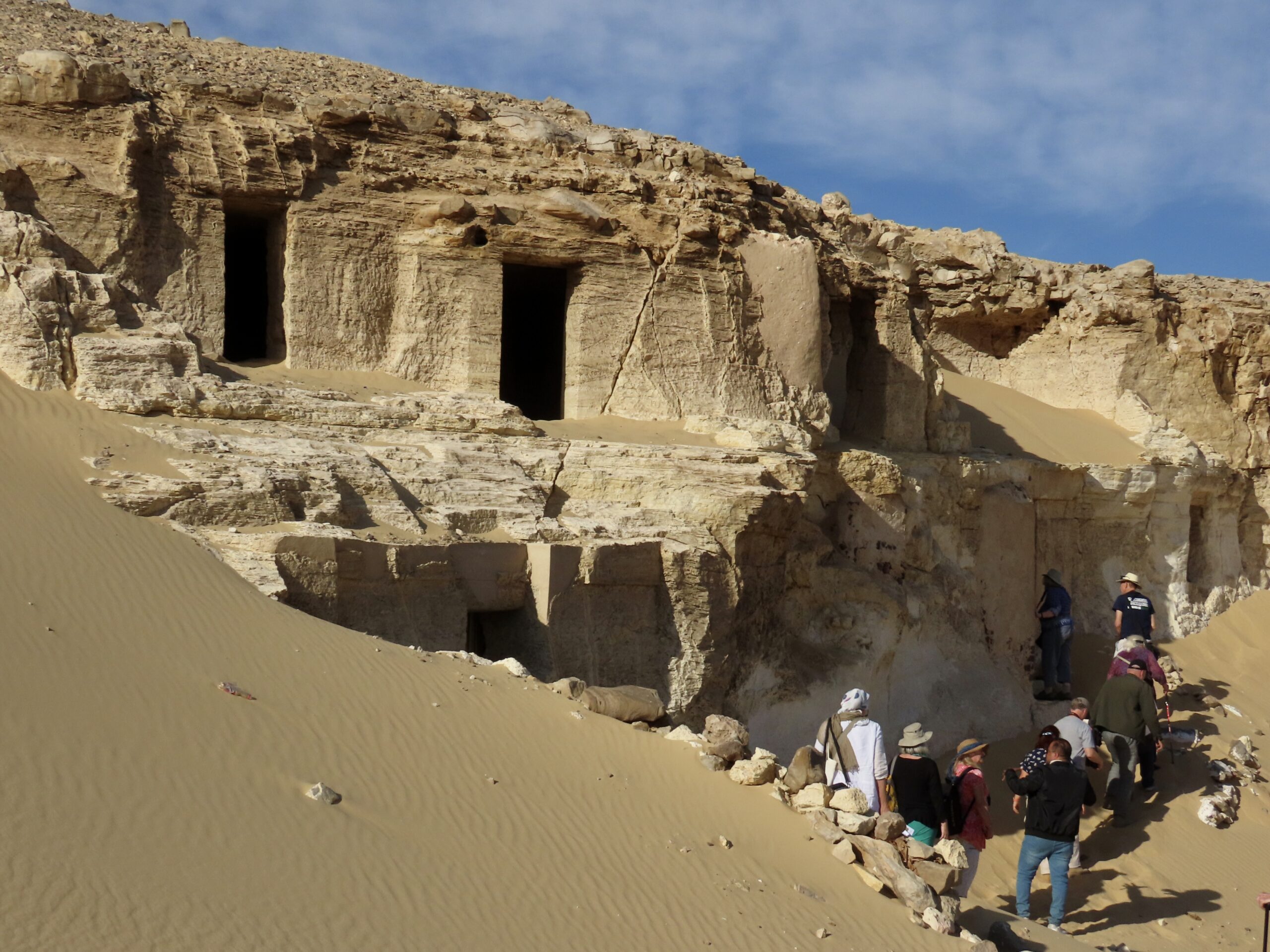
The Old Kingdom/6th dynasty tombs are located on the other side of the cemetery, across the wadi. So we took a hike across the sandy hills.


Just like the cemetery at Qaw el Kebir, these cliffs were occupied by Coptic monks from the early Christian era through the Byzantine era (c. 30 BCE – 640 CE, date of the Arab invasion). Egypt’s desert was the location of choice for hermits in Christianty’s early centuries. They would occupy ancient tombs and also hack out cells for themselves in the limestone cliffs.




Old Kingdom Tombs
As noted above, the first officials to govern at Qis were appointed by Pepi I and buried at Quseir el Amarna, a cemetery across the Nile on the east bank. The first appointment was a man called Khewen-wekh/Tetji (Quseir tomb 2), whose provincial governing title was “First Overseer of Priests of Hathor, Lady of Qis.” He was sent here from the capital, and his other titles suggest that he was a big-wig there and very close to ruler: “Elder of the Robing Room, Priest of the Red Crown (reflecting sacred rituals in robing the ruler); Priest of Heka (magic), Privy to the Secrets of the Sacred Books, Magician of the Ruler” (plus others).
Khewen-wekh/Tetji was succeeded by another capital transplant appointed by Pepi I: Pepi-ankh-wr/the Elder, whose titles were “Overseer of Priests of Hathor, Lady of Qis.” He was buried with his wife in tomb 1 at Quseir al-Amarna.
And now for a little sidestep into the network of powerful families controlling Egypt at this time. (Oligarchy and nepotism have a long and storied history.) Remember those assassinations and revolts detailed by Kanawati in Conspiracies in the Egyptian Palace? Pepi-ankh-wr and his family were likely in the thick of things.
Teti (1st ruler of the 6th Dynasty) had a murky claim to the throne, which he tried to strengthen by marrying his daughters to leading men in powerful families. Many of these men were older, with grown families, and a number of elder sons were effectively disinherited, since children produced with the royal wives took precedence (see rebellion #3). Teti was eventually assassinated “by his guards,” according to the Greek historian Manetho, so it’s not clear how well his strategy worked. But he had a lot of daughters to marry off, and these marriages created connections among powerful families in the capital and in those rich middle Egypt nomes.
Pepy-ankh-wr’s wife, Sesheshet, was likely one of those Teti daughters. This made him son-in-law to Teti and uncle to Pepi I, Teti’s only son. Teti’s eldest daughter, Waatetkhethor, was married to the vizier Mereruka. So Pepy-ankh-wr was also linked, through these in-laws, to the powerful Seshemnefer family at Giza/Saqqara. (See my blog post “The Mastaba of Mereruka and Waatetkhethor” to learn more or, for more detail, check out my 2019 presentation notes in MEET THE SESHEMNEFERS! How Family, Politics & Economics Fueled Mereruka’s Rise to The Top in Old Kingdom Egypt.)
After Teti’s assassination, Pepi I came to the throne as a small child with his mother, Iput I, serving as regent. Loyalty to Iput/Pepi I in this fraught time was likely at a premium. Members of the Pepy-ankh family demonstrated their loyalty through their formal name: Pepy-ankh means something like “long life to Pepi.” They were rewarded with plum assignments to lucrative positions, like Pepy-ankh-wr’s appointment as “Overseer of Priests of Hathor at Qis,” one of the richest regions in Egypt.
Pepy-ankh-wr’s son, Sobekhhotep Hepi, continued to serve in the capital, and was (possibly) buried there. He pre-deceased his father and therefore did not succeed to his father’s titles in Qis.
The grandson of Pepy-ankh-wr and Sesheshet, Pepy-ankh Hery-ib, also spent time in the capital before taking over his grandfather’s roles in governing Qis. Pepy-ankh Hery-ib was the first member of the family to hold civil administrative titles as well as religious ones, including “Overseer of Upper Egypt in the Middle Provinces” and “Overseer of Upper Egypt in Reality” (suggesting authority over Thebes and thus the entire south.) He lived to be over 100, so was a force in Egyptian politics for a very long time. Pepy-ankh Hery-ib moved the Qis elite cemetery from Quseir el-Amarna to Meir, where he is buried in tomb D2. Reliefs in his tomb use a special hieroglyphic determinative to emphasize his royal descent from Teti.
From this point on, the position of “governor” of Qis was hereditary, filled first by Pepy-ankh-wr’s grandson (Pepy-ankh Hery-ib, Tomb D2); then his great grandson (Niankh-pepy-kem, Tomb A1, with burial in A4); a great-great grandson (Pepiankh Heny-kem, Tomb A2); a great-great-great grandson (Heny, possibly buried in Tomb A2, Room F); and finally, a great-great-great grandson (Hepi, Tomb unknown) who served the short-lived ruler Merenre Nemtyemsaf II as the Old Kingdom came stumbling to an end. (For Egyptology nerds: I’m using Naguib Kanawati’s genealogy rather than Blackmun’s, with the Room F addition suggested by James Michael Simons.)
We visited the A1/A2 complex of connected family tombs

One final note on conspiracies and familial interconnections before diving into this tomb complex. In the latter part of Pepi I’s reign, a queen was tried for treason. Her judge was a man called Weni, member of an elite family at Abydos whose father served as one of Pepi’s viziers, and who went on to have a distinguished career. (Note: Egyptians usually did not record chaotic events like assassinations, rebellions and treason in order to avoid giving chaos a foot in the door. We know about this trial of the [nameless] queen because Weni wrote about it in his tomb biography at Abydos, where it was presumably far enough away from the capital, in both time and space, to avoid notice.)
Possibly in response to this “harem conspiracy,” Pepi I tried to strengthen his claim to the throne by marrying into another powerful Abydene family. He appointed the family matriarch, a woman called Nebet, as vizier (the first woman vizier, and a rarity overall). Pepi I first married Nebet’s elder daughter, Ankhnespepi I (mother of his successor Merenre), then later married her sister, Ankhnespepi II (mother of Pepi II, who succeeded Merenre as a small child). Their brother Djau succeeded his mother as vizier, establishing a powerful hereditary provincial “governorship” just like the Pepy-ankh family at Qis. So the Djau and Pepy-ankh families were contemporaries and related, through Pepi I, as in-laws. Kanawati notes a number of features in their tombs suggesting that they shared common social/cultural outlooks.
Niankh-pepy Kem (Tomb A1)
On to the pictures! We entered the complex though Tomb A1, Niankh-pepy-kem, who lived in the reign of Pepi II. Tomb A2 is visible on the other side of the pillar in the 2nd photo.


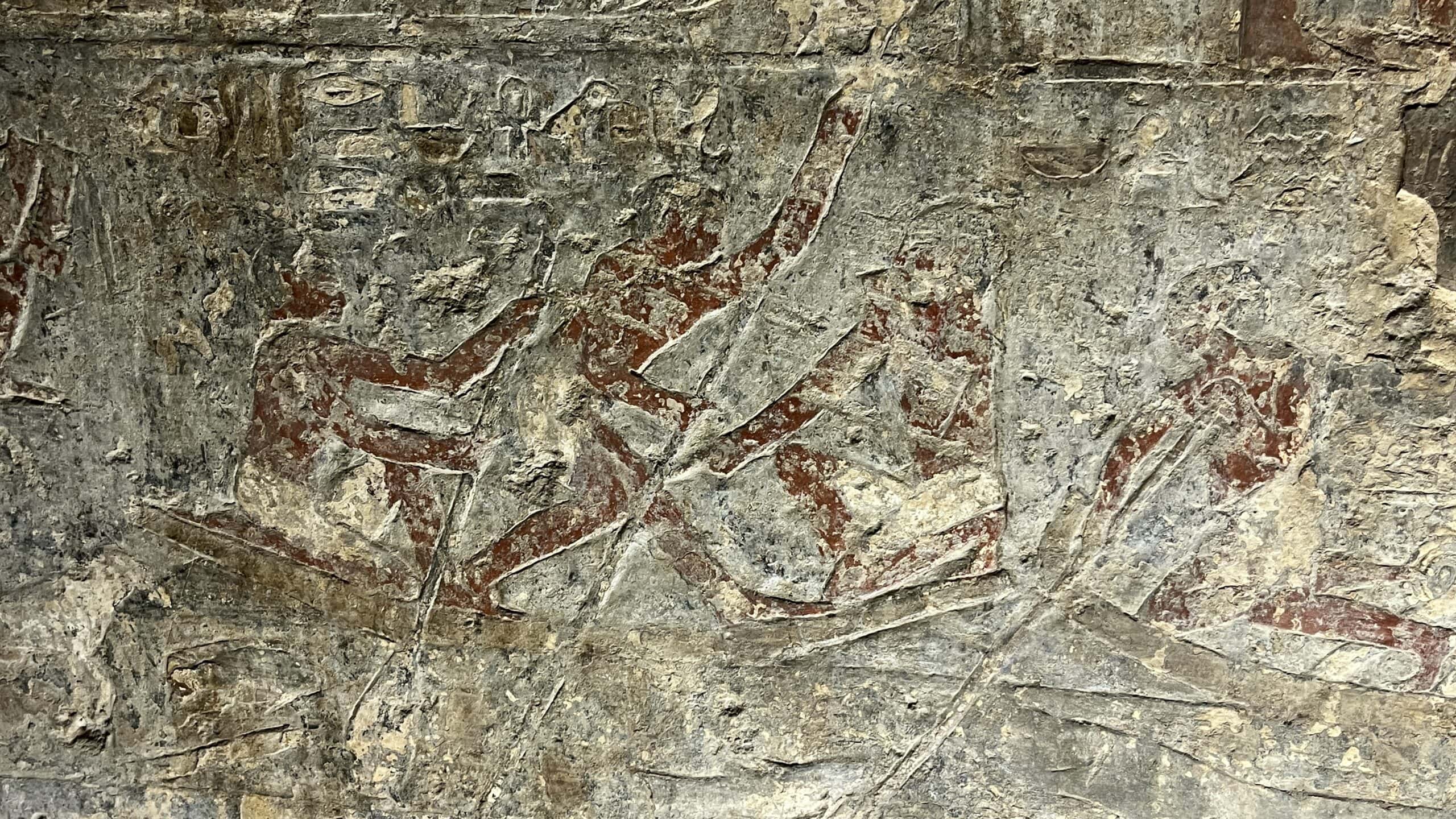
The chapel walls are decorated with both paintings and low reliefs. One wall closely mirrors the “fishing in the marshes” scene from the mastaba of Mereruka, including a crocodile lurking below the papyrus boat and species-specific images of Nile fish.


This bigger-than-life-size statue is also directly out of the Mereruka playbook. Sadly, not a lot remains.

Other images are very similar to those we saw in the Middle Kingdom tombs, dominated by offering scenes, family pictures and scenes of daily life. The last photo in this group is a false door, that magical doorway between the afterlife and the living world.




Pepyankh Heny-kem (Tomb A2)
Pepiankh Heny-kem constructed A1 as a chapel for his father, whose burial chamber (A4) lies behind/beneath the complex, accessed through a room Blackmun labeled as Room D. Pepiankh Heny-kem then constructed his own tomb and multi-room chapel (A2) as an extension of his father’s. Pepiankh Heny-kem’s son, Heni, may have built his own chapel as an extension to his father’s chapel (Room F – disputed). Wall decorations are similar in A1-A2, and both tombs contain scenes where the sons make offerings to the fathers.


Here’s the ever-intrepid Katherine exploring the tunnel that connects to the burial chamber of Pepy-ankh-kem (Room D in the plan view).


A door was carved through Room F (the east wall of the A2 chapel, possibly belonging to Heny) to create yet another extension whose owner is not firmly identified. This room (H) has unfinished walls and a ka chapel with some empty spots where statues once stood. I find rooms like this especially interesting because we can see how the reliefs were created: sketch artists drew the images, then sculptors carved the images in stone, followed by another set of artists who added color.


Satiated with tombs, it was time to hike back down the sandy path. (Unfortunately, I did not get the name of the Meir Inspector who’s giving us the thumbs-up.)


On to Minya
Back on the bus, Salah drove us north to Minya.


We spent the night in the Nefertiti Minya Hotel, where there was much chaos: rooms not ready, swipe keys not working and misplaced bags. My bag was initially among the lost, but was eventually found tucked in the back of the bus luggage compartment. After changing my swipe card three times, I found that the door to my room would not lock and insisted on moving to another room. Kay had it the worst: her bag was lost and never turned up, even though Amr followed up with the hotel for days. Fortunately, Kay had kept her valuables with her on-the-bus bag, and other members of the tour were able to lend some clothes.
I think the agent of chaos was the really scary animated Santa Claus in the hotel lobby. Set in a Santa suit?


What an amazing journey! Thank you for sharing. BTW, I agree, if only we could resurrect Amenemhat.