Sunday morning was one of the most amazing experiences of my life: hours spent up close and personal with dozens of species of wildlife at Mashatu’s Matebole photographic hide.
We departed camp at 5:30 am in order to catch the best light.


Wildlife photography is one of the “experiences” available at Mashatu. They partner with Photo Mashatu and offer three options for photographers who want to go deeper: private game drives; an overnight at the “sleep-in hide” and watering hole; and a morning at the “sunken” hide and very busy waterhole at Matebole. A professional wildlife photographer accompanies visitors in all cases, offering tips and practical help to make those photos even more memorable.
Our photographer was Joe Misika, a Botswana native, who (among other awards) was the Botswana Wildlife Photographer of the Year in 2020. Joe started out working in IT in Johannesburg, but didn’t like the job. He earned enough to buy a good camera and teach himself photography, and now he does the marketing photos for Photo Mashatu as well as guiding at the hides, in vehicles and on walks. Joe was a delight, identifying species for us and spending a lot of time giving tips to Don and Ken (who were using SLR cameras) as well as deciphering the mysteries of iPhone photography for Judy and Barb.


Elephants are regular and frequent visitors, and we got settled in just in time for the first wave. Elephants must drink daily, and they drink a lot – basically draining the waterhole every day. A borehole refills the waterhole overnight.


This little ellie boy was such a delight, strutting his stuff as he cleared the waterhole of “competitors.” He was the advance guard for the rest of his family.
The birdlife was astounding, with feathered bodies constantly in motion. The Red-billed Quelea were most abundant: this species is reportedly the most populous bird in the wild, with numbers in the billions in Sub-Saharan Africa. They are always seen in very large flocks. Farmers hate them because a flock can decimate a field of sorghum or wheat before the farmers can harvest the grain. Joe said that pesticides used to be used in an attempt to control them, but this was ineffective. People are now having success by bringing in falcons who hunt for a couple of days, taking out a few birds. The flock then gets wise to the falcons’ presence and won’t return. Folks are also now using drones.


The Pell’s Spotted Owlet that we saw perched in a tree yesterday made an appearance, hunting for its breakfast. It was a fast and deadly hunter, not much bigger than the birds that were its prey. After much observation and several misses, the owlet nabbed a Golden Breasted Bunting and flew it up to a tree.


Golden Breasted Bunting it has captured


Larger species came and went, with the birds as a constant backdrop.


Giraffes are now more endangered than elephants, with only about he 117,000 wild giraffes left worldwide. Last year, the US Fish and Wildlife Service proposed to add giraffes to the Endangered Species Act, which would prohibit import of hunting trophies and other giraffe body parts into the USA. The proposed rule is pending…
The giraffes that approached the waterhole were very skittish, more aware – and worried about – our presence than any other species. Joe cautioned us to be very quiet and still as they approached.


Mashatu has about 1000 resident elephants, and more bands came by later in the morning. They spread out around the waterhole, with some less than 5 feet away. Where humans are left-or right-handed, elephants are left- or right-trunked. They were close enough that they could have used their trunks to snatch our cameras if so inclined.


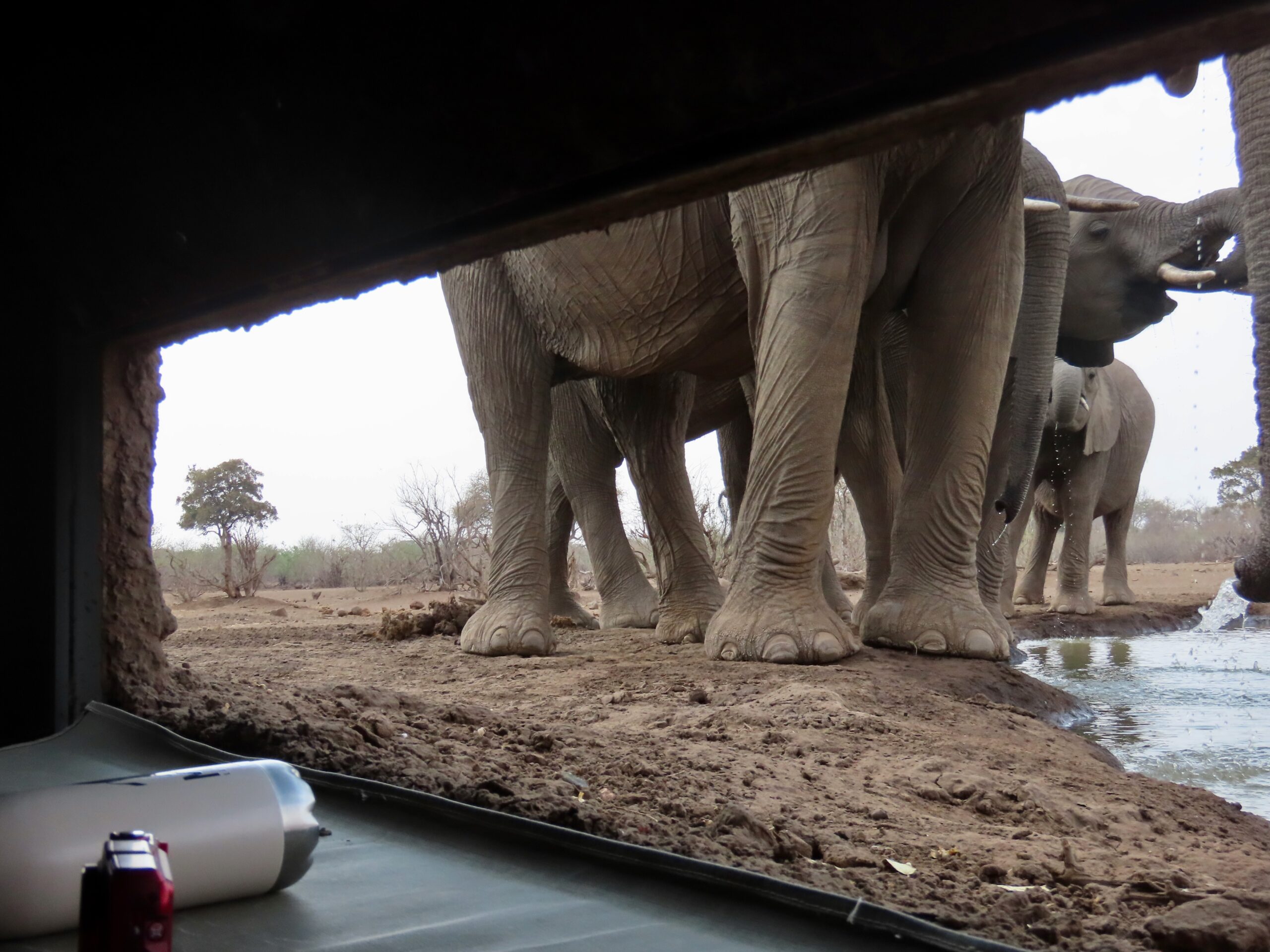


It was hard to leave the (relatively cool) hide and re-emerge into the (very hot) rest of the world, but after three hours our time was up. Once Joe gave us the all clear (after scouting for incoming critters) we climbed up the ladder and scurried into the vehicles for the drive back to camp.
We were entertained at breakfast by an assortment of wild friends.


I badly wanted these guys to be mongoose,
but the others prevailed in their identification as a squirrel.
Still very entertaining antics.


Monica, one of the core staff, told us that the squirrels (and others) have very little to eat at this time of year, and the situation would soon be desperate if the rains didn’t come. At her village, the water in their borehole is so low that they have to winch very deeply in the ground and then bring up only a few cups of water. They are very worried about their goats and cattle, as well as the animals in the reserve. (The rains did come soon after, at above-normal levels. Botswana and other central/southern African nations were coping with heavy flooding in the spring.)
As tourists, getting enough to eat was never a problem, but avoiding heat stroke was. From late morning to mid-afternoon, our crew pursued different strategies to cool off in the +100 degrees heat. The gals headed to the pool, where we inched our way into the very cold water, eventually immersing for a great full body cool-off. We then hung out on lounges i the shade, draped with towels soaked in cold water, which was an effective way to beat the heat. The guys, meanwhile, just sat/lay around sweltering.

Heading out for the afternoon drive, two of said guys asked for the vehicle’s top to be put on to provide some shade. After an hour or so of struggling for views amidst gentle squabbling over seats, we all agreed that drives with the top on are horrible: folks at the back (who are on elevated seats) have a very small visual window between the vehicle’s top and the heads of people in the front row seats. Travel tip: do not go on safari with the top on! But we’ve been traveling together for a long time, so were able to shift and maneuver enough to accommodate everyone as we enjoyed more great encounters in the bush.


We drove far to the west in search of two lionesses with small cubs, part of the “Big Boy” pride we had watched yesterday. We spent some time searching and poking around in an area with lots of willow-like bushes providing dense cover, which Dan said “is where they hide the small ones.” Then we drove down the steep bank of a dry riverbed and found one mother and a 4-5 month old cub lounging on the western bank.


She kept shifting position, trying to find a cool spot


Two other cubs came trundling out of the bushes and proceeded to annoy the lioness. She eventually stalked off in a huff, heading back into the bushes where there was some shade and less room for juvenile attacks.


Sundowner came with a glorious sunset.


It was a long drive back to camp, with a number of non-photographable sightings: an African Eagle Owl lifting off from the forest floor; a group of Spring Hares bouncing into their holes, eyes glowing in the light; three hyenas; and the carcass of a recently dead Steenbok in the road. The Steenbok was not a kill: Dan said it might have been killed by too much tannin in the leaves it was eating or by a snakebite – Puff Adders hide in the short shrubs on which Steebok feed.
We were very late for dinner, a delicious buffet in the boma with four new guests from Australia.



Excellent photos!
Great to read! We have fond memories of the buried hide :-).
Wow! To be so close and personal with the animals is such a precious experience. Loved all the bird close-ups, and the lion cubs pulling moms tail. Haha!